
Virus Bulletin
Copyright © 2025 Virus Bulletin
In the Q3 2025 VBSpam test – which forms part of Virus Bulletin’s continuously running security product test suite – we measured the performance of a number of email security solutions against various streams of wanted, unwanted and malicious emails. Half of the solutions we tested opted to be included in the public test, the rest opting for private testing (all details and results remaining unpublished). The solutions tested publicly – and included in this report – were nine full email security solutions and one open-source solution.
Overall, we continue to see good performance from the tested solutions, which manage to keep up with the latest threats. We note that adversaries are increasingly blending social engineering with technical evasion – using familiar brands to lower skepticism while hiding malicious logic in unconventional file formats – to bypass security filters and coerce end-user interaction.
For some additional background to this report, the table and map below show the geographical distribution (based on sender IP address) of the spam emails seen in the test1. (Note: these statistics are relevant only to the spam samples we received during the test period.)
| # | Sender's IP country | Percentage of spam |
| 1 | United States | 25.37% |
| 2 | China | 17.56% |
| 3 | Brazil | 8.53% |
| 4 | Japan | 3.23% |
| 5 | Argentina | 2.56% |
| 6 | Russian Federation | 2.37% |
| 7 | India | 2.04% |
| 8 | France | 1.38% |
| 9 | United Kingdom | 1.37% |
| 10 | Germany | 1.04% |
Top 10 countries from which spam was sent.
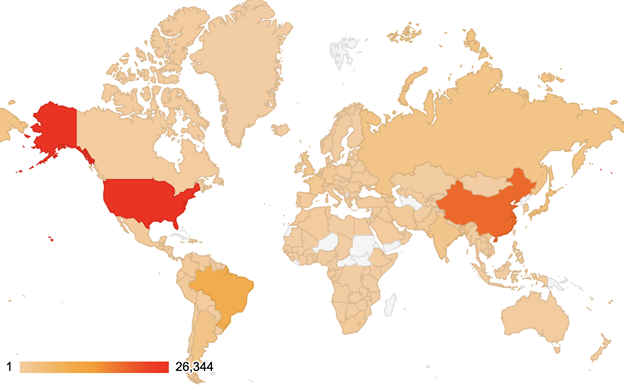
Geographical distribution of spam based on sender IP address.
This test was executed in accordance with the AMTSO Standard of the Anti-Malware Testing Standards Organization. The compliance status can be verified on the AMTSO website:
The spam campaign that was missed by the majority of the tested solutions involved emails exploiting the Google Classroom service2. We detected it being active from 6 to 14 August.
The emails appear to be from Google Classroom (no‑[email protected][.]com), but the subject and body reference a WhatsApp contact for bulk orders, which is not aligned with Google Classroom’s purpose.
The messages urge the recipient to send a ‘full offer’ to a specific WhatsApp number. This tactic is an attempt to move the conversation outside email security controls, where attackers can phish for personal or business data, trick victims into financial fraud, or distribute malware.
The emails contain links that appear to point to Google accounts and Google Classroom, but are heavily parameterized redirects (notifications.googleapis.com/email/redirect?...).
The text warns ‘if you accept [the invitation], your contact information will be shared’. This suggests attackers are trying to collect personal information, potentially exposing email addresses, names and contacts.
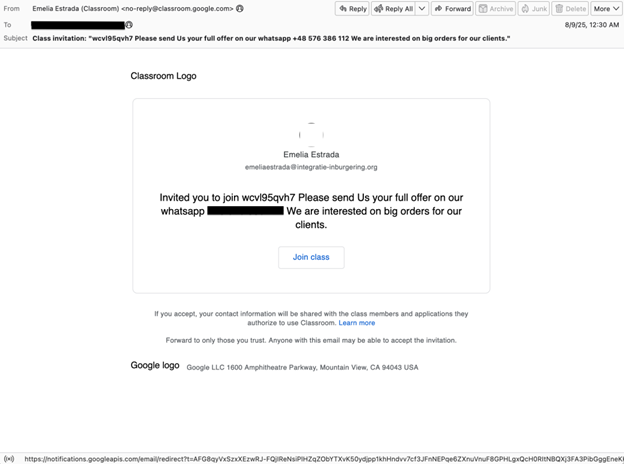 Google Classroom phishing email.
A recent phishing campaign leveraged a malicious SVG email attachment masquerading as a missed call notification. Instead of containing a harmless graphic, the file embedded heavily obfuscated JavaScript designed to execute when opened in a browser or compatible viewer.
The script attempted to run meaningless ‘JSFuck’-style3 code that was deliberately crafted to fail, forcing execution into a fallback routine that redirected victims to httpx://pichtos[.]org/phonedesk//#2q042q04. At the time of our analysis the URL was unavailable, but we saw reports of similar payloads leading to a clickjack trojan used to like and promote social media posts4.
This approach illustrates a growing trend in email-borne threats: attackers combining uncommon file formats with deceptive obfuscation to evade automated scanning, while ensuring a reliable redirection to external phishing infrastructure once the attachment is opened.
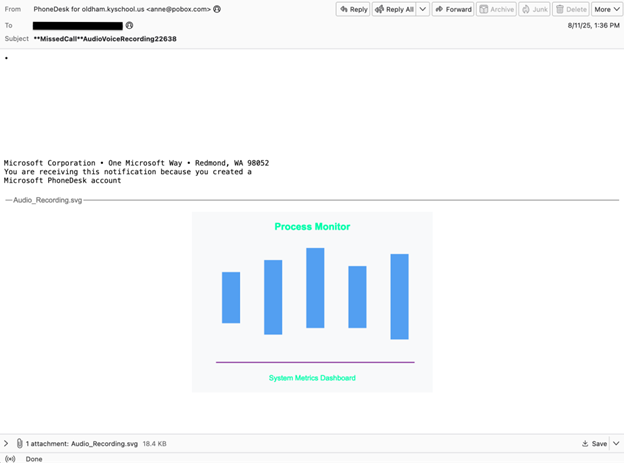 SVG malicious sample.
 A part of the JavaScript payload from the SVG attachment.
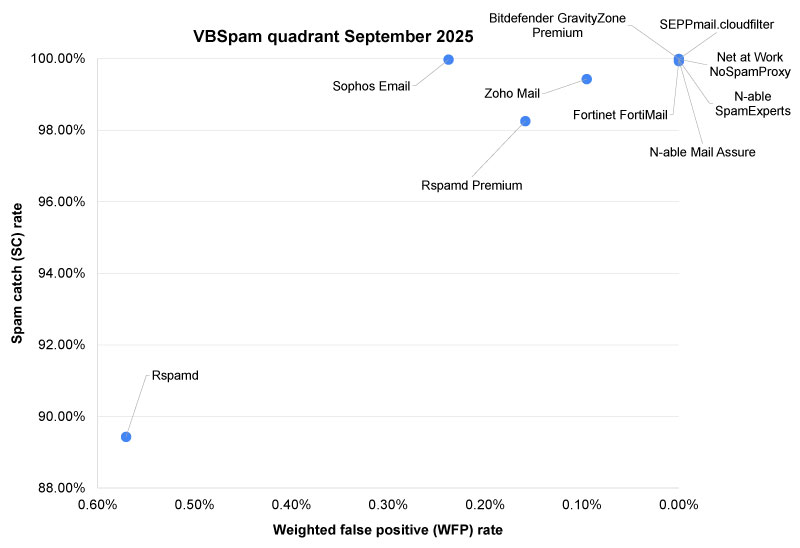
Of the participating full solutions, two achieved a VBSpam award – Sophos Email and Zoho Mail – while six – Bitdefender GravityZone Premium, FortiMail, N-able Mail Assure, N-able SpamExperts, Net at Work NoSpamProxy and SEPPmail.cloudfilter – were awarded a VBSpam+ certification.
(Note: since, for a number of products, catch rates and/or final scores were very close to, whilst remaining a fraction below, 100%, in this test we quote all the spam-related scores with three decimal places.)
|
SC rate: 99.990%
|
 |
Bitdefender’s product achieved excellent results in this test, earning a well-deserved VBSpam+ award. Notably, it recorded no false negatives on the malware corpus and zero false positives of any kind.
|
SC rate: 99.929%
|
|
Fortinet’s filters successfully blocked all malware samples and produced no false positives. This performance earned FortiMail a VBSpam+ certification for the Q3 2025 VBSpam test, with a final score of 99.929.
|
SC rate: 99.967%
|
|
N-able Mail Assure demonstrated excellent all-round performance with a 99.96% spam detection rate, zero false positives, and a final score of 99.967 – easily earning VBSpam+ certification.
|
SC rate: 99.969%
|
|
With similarly impressive scores to those of its sister product, N-able SpamExperts also earns VBSpam+ certification.
|
SC rate: 99.981%
|
|
NoSpamProxy earns VBSpam+ certification with a final score of 99.981, having blocked all malware samples and having produced no false positives.
|
SC rate: 89.429%
|
The open-source Rspamd found dealing with the malware samples a challenge. However, we continue to see good performances from the solution on the overall spam corpus, in this case blocking more than 89% of the samples.
|
SC rate: 98.250%
|
The upgraded Rspamd configuration significantly outperformed the basic version, successfully blocking 98.25% of spam samples and achieving a final score of 97.457.
|
SC rate: 99.983%
|
|
SEPPmail.cloudfilter achieved VBSpam+ certification in this test, successfully blocking all malware and phishing samples and producing zero false positives.
|
SC rate: 99.970%
|
 |
Sophos Email earned VBSpam certification in this test, successfully blocking all phishing samples and missing only one malware sample.
|
SC rate: 99.426%
|
|
Zoho Mail earned VBSpam certification in this test, achieving higher than 99% catch rates on the malware and phishing samples as well as on the overall spam corpus.
| True negatives | False positives | FP rate | False negatives | True positives | SC rate | Final score | VBSpam | |
| Bitdefender GravityZone Premium | 1255 | 0 | 0.00% | 10 | 103817 | 99.990% | 99.990 |  |
| Fortinet FortiMail | 1255 | 0 | 0.00% | 74 | 103753 | 99.929% | 99.929 | |
| N-able Mail Assure | 1255 | 0 | 0.00% | 34.2 | 103792.8 | 99.967% | 99.967 | |
| N-able SpamExperts | 1255 | 0 | 0.00% | 32.2 | 103794.8 | 99.969% | 99.969 | |
| Net at Work NoSpamProxy | 1255 | 0 | 0.00% | 19.6 | 103807.4 | 99.981% | 99.981 | |
| Rspamd | 1248 | 7 | 0.56% | 10975.8 | 92851.2 | 89.429% | 86.575 | |
| Rspamd Premium | 1253 | 2 | 0.16% | 1817 | 102010 | 98.250% | 97.457 | |
| SEPPmail.cloudfilter | 1255 | 0 | 0.00% | 18 | 103809 | 99.983% | 99.983 | |
| Sophos Email | 1252 | 3 | 0.24% | 31.4 | 103795.6 | 99.970% | 98.781 |  |
| Zoho Mail | 1254 | 1 | 0.08% | 595.8 | 103231.2 | 99.426% | 98.951 | |
| Newsletters | Malware | Phising | Project Honey Pot | Abusix | MXMailData | STDev† | |||||||
| False positives | FP rate | False negatives | SC rate | False negatives | SC rate | False negatives | SC rate | False negatives | SC rate | False negatives | SC rate | ||
| Bitdefender GravityZone Premium | 0 | 0.0% | 0 | 100.000% | 1 | 99.997% | 5 | 99.993% | 5 | 99.984% | 0 | 100.000% | 0.11 |
| Fortinet FortiMail | 0 | 0.0% | 0 | 100.000% | 17 | 99.940% | 52 | 99.924% | 18 | 99.944% | 4 | 99.880% | 0.34 |
| N-able Mail Assure | 0 | 0.0% | 0 | 100.000% | 3 | 99.990% | 5 | 99.993% | 29.2 | 99.908% | 0 | 100.000% | 0.18 |
| N-able SpamExperts | 0 | 0.0% | 0 | 100.000% | 3 | 99.990% | 5 | 99.993% | 27.2 | 99.915% | 0 | 100.000% | 0.18 |
| Net at Work NoSpamProxy | 0 | 0.0% | 0 | 100.000% | 1 | 99.997% | 12.2 | 99.982% | 7.4 | 99.977% | 0 | 100.000% | 0.29 |
| Rspamd | 1 | 3.0% | 149 | 73.060% | 1289 | 95.750% | 7983.2 | 88.345% | 1902.6 | 94.037% | 1090 | 68.200% | 7.15 |
| Rspamd Premium | 0 | 0.0% | 5 | 99.100% | 245 | 99.190% | 1227 | 98.209% | 241 | 99.245% | 349 | 89.820% | 1.73 |
| SEPPmail.cloudfilter | 0 | 0.0% | 0 | 100.000% | 0 | 100.000% | 17 | 99.975% | 0 | 100.000% | 1 | 99.970% | 0.37 |
| Sophos Email | 0 | 0.0% | 1 | 99.820% | 0 | 100.000% | 22 | 99.968% | 8.4 | 99.974% | 1 | 99.970% | 0.12 |
| Zoho Mail | 1 | 3.0% | 1 | 99.820% | 38 | 99.870% | 510.8 | 99.254% | 83 | 99.740% | 2 | 99.940% | 0.84 |
† The standard deviation of a product is calculated using the set of its hourly spam catch rates.
| Speed | ||||
| 10% | 50% | 95% | 98% | |
| Bitdefender GravityZone Premium |  |
|
|
|
| Fortinet FortiMail | |
|
|
|
| N-able Mail Assure | |
|
|
|
| N-able SpamExperts | |
|
|
|
| Net At Work NoSpamProxy | |
|
|
|
| Rspamd | |
|
|
|
| Rspamd Premium | |
|
|
|
| SEPPmail.cloudfilter | |
|
|
|
| Sophos Email | |
|
|
|
| Zoho Mail | |
|
|
 |
|
0-30 seconds | |
30 seconds to two minutes |  |
two minutes to 10 minutes |  |
more than 10 minutes |
| Products ranked by final score | |
| Bitdefender GravityZone Premium | 99.990 |
| SEPPmail.cloudfilter | 99.983 |
| Net at Work NoSpamProxy | 99.981 |
| N-able SpamExperts | 99.969 |
| N-able Mail Assure | 99.967 |
| Fortinet FortiMail | 99.929 |
| Zoho Mail | 98.951 |
| Sophos Email | 98.781 |
| Rspamd Premium | 97.457 |
| Rspamd | 86.575 |
| Hosted solutions | Anti-malware | IPv6 | DKIM | SPF | DMARC | Multiple MX-records | Multiple locations |
| N-able Mail Assure | N-able Mail Assure | √ | √ | √ | √ | ||
| N-able SpamExperts | SpamExperts | √ | √ | √ | √ | ||
| Net At Work NoSpamProxy | 32Guards & NoSpamProxy | √ | √ | √ | √ | √ | |
| Rspamd Premium | ClamAV | √ | √ | √ | √ | √ | |
| SEPPmail.cloudfilter | SEPPmail, ClamAV & ESET | √ | √ | √ | √ | √ | √ |
| Sophos Email | Sophos | √ | √ | √ | √ | √ | √ |
| Zoho Mail | Zoho | √ | √ | √ | √ | √ |
| Local solutions | Anti-malware | IPv6 | DKIM | SPF | DMARC | Interface | |||
| CLI | GUI | Web GUI | API | ||||||
| Bitdefender GravityZone Premium | Bitdefender | √ | √ | √ | √ | ||||
| Fortinet FortiMail | Fortinet | √ | √ | √ | √ | √ | √ | √ | |
| Rspamd | None | √ | |||||||
The full VBSpam test methodology can be found at https://www.virusbulletin.com/testing/vbspam/vbspam-methodology/vbspam-methodology-ver30/.
The test ran for 16 days, from 12am on 2 August to 12am on 18 August 2025 (GMT).
The test corpus consisted of 105,131 emails. 103,843 of these were spam, 68,502 of which were provided by Project Honey Pot, 31,913 were provided by Abusix, with the remaining 3,428 spam emails provided by MXMailData. There were 1,255 legitimate emails (‘ham’) and 33 newsletters, a category that includes various kinds of commercial and non-commercial opt-in mailings.
20 emails in the spam corpus were considered ‘unwanted’ (see the June 2018 report) and were included with a weight of 0.2; this explains the non-integer numbers in some of the tables.
Moreover, 553 emails from the spam corpus were found to contain a malicious attachment while 30,353 contained a link to a phishing or malware site; though we report separate performance metrics on these corpora, it should be noted that these emails were also counted as part of the spam corpus.
Emails were sent to the products in real time and in parallel. Though products received the email from a fixed IP address, all products had been set up to read the original sender’s IP address as well as the EHLO/HELO domain sent during the SMTP transaction, either from the email headers or through an optional XCLIENT SMTP command5.
For those products running in our lab, we all ran them as virtual machines on a VMware ESXi cluster. As different products have different hardware requirements – not to mention those running on their own hardware, or those running in the cloud – there is little point comparing the memory, processing power or hardware the products were provided with; we followed the developers’ requirements and note that the amount of email we receive is representative of that received by a small organization.
Although we stress that different customers have different needs and priorities, and thus different preferences when it comes to the ideal ratio of false positive to false negatives, we created a one-dimensional ‘final score’ to compare products. This is defined as the spam catch (SC) rate minus five times the weighted false positive (WFP) rate. The WFP rate is defined as the false positive rate of the ham and newsletter corpora taken together, with emails from the latter corpus having a weight of 0.2:
WFP rate = (#false positives + 0.2 * min(#newsletter false positives , 0.2 * #newsletters)) / (#ham + 0.2 * #newsletters)
while in the spam catch rate (SC), emails considered ‘unwanted’ (see above) are included with a weight of 0.2.
The final score is then defined as:
Final score = SC - (5 x WFP)
In addition, for each product, we measure how long it takes to deliver emails from the ham corpus (excluding false positives) and, after ordering these emails by this time, we colour-code the emails at the 10th, 50th, 95th and 98th percentiles:
|
(green) = up to 30 seconds |
|
(yellow) = 30 seconds to two minutes |
|
(orange) = two to ten minutes |
|
(red) = more than ten minutes |
Products earn VBSpam certification if the value of the final score is at least 98 and the ‘delivery speed colours’ at 10 and 50 per cent are green or yellow and that at 95 per cent is green, yellow or orange.
Meanwhile, products that combine a spam catch rate of 99.5% or higher with a lack of false positives, no more than 2.5% false positives among the newsletters and ‘delivery speed colours’ of green at 10 and 50 per cent and green or yellow at 95 and 98 per cent earn a VBSpam+ award.
1 For a number of samples (10,088 spam samples; 9.71% of the total) we were unable to find data about geographical location based on IP address.
2 https://blog.checkpoint.com/email-security/phishing-in-the-classroom-115000-emails-exploit-google-classroom-to-target-13500-organizations/.
4 https://www.malwarebytes.com/blog/news/2025/08/adult-sites-trick-users-into-liking-facebook-posts-using-a-clickjack-trojan?x-clickref=1101lBHcHKpr.
5 http://www.postfix.org/XCLIENT_README.html.



