
Virus Bulletin
Copyright © 2026 Virus Bulletin
In the Q3 2026 VBSpam test – which forms part of Virus Bulletin's continuously running security product test suite – we measured the performance of a number of email security solutions against various streams of wanted, unwanted and malicious emails. Half of the solutions we tested opted to be included in the public test, the rest opting for private testing (all details and results remaining unpublished). The solutions tested publicly – and included in this report – were ten full email security solutions and one open-source solution.
The threats observed during this period demonstrate how modern phishing campaigns increasingly blend familiar business and consumer lures with lightweight evasive infrastructure. Rather than relying on obvious malware attachments, these messages used convincing account, invoice, banking, and subscription pretexts to push users toward external web flows where the real risk emerged only after redirects, browser checks, or unusual URL encoding. This made them difficult for email security solutions to block, as the malicious intent was distributed across social engineering, authenticated or plausible sender infrastructure, and cloaked destinations that could appear benign to static scanners or simplified sandbox analysis.
For some additional background to this report, the table and map below show the geographical distribution (based on sender IP address) of the spam emails seen in the test1. (Note: these statistics are relevant only to the spam samples we received during the test period.)
| # | Sender’s IP country | Percentage of spam |
| 1 | United States | 67.54% |
| 2 | China | 7.06% |
| 3 | Russian Federation | 3.36% |
| 4 | Japan | 2.37% |
| 5 | Asia/Pacific Region | 2.26% |
| 6 | United Kingdom | 1.25% |
| 7 | Canada | 0.99% |
| 8 | Germany | 0.86% |
| 9 | Netherlands | 0.84% |
| 10 | Brazil | 0.74% |
Top 10 countries from which spam was sent.
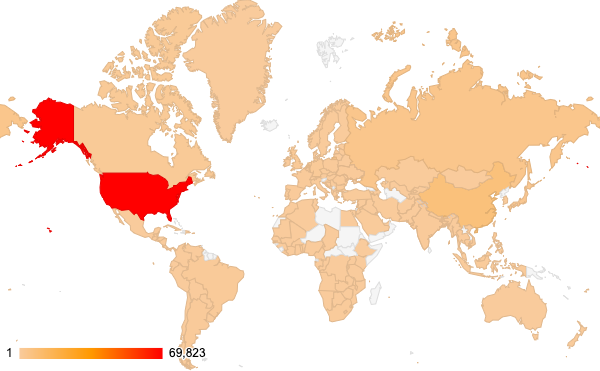 Geographical distribution of spam based on sender IP address.
This test was executed in accordance with the AMTSO Standard of the Anti-Malware Testing Standards Organization. The compliance status can be verified on the AMTSO website:
During this period we observed a Dutch-language antivirus‑themed phishing sample impersonating McAfee/TotalAV and warning recipients that their device was infected with '631 dangerous viruses'. The message used urgency, account-closure threats, and a 90% discount lure to push users towards a renewal action through sanitized redirect infrastructure such as 31-59-175-195[.]syd[.]nbn[.]aussiebb[.]net, loadswage[.]com, and an unsubscribe path on eightindigostove[.]com.
The final threat was assessed as fake antivirus renewal scareware/subscription fraud, likely intended to monetize clicks through a deceptive renewal or affiliate funnel and potentially collect payment details, rather than deliver a confirmed malware payload.
The sample was challenging for security solutions because it contained no attachment or executable, relied on HTML‑only social engineering, used a legitimate-looking sender domain, separated tracking/unsubscribe/CTA URLs, and routed users through live redirect infrastructure whose final destination could change, expire, or cloak by time and location.
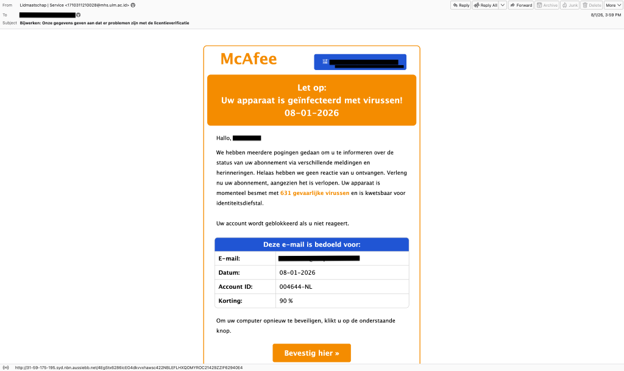 Antivirus renewal phishing sample.
A notable August 2026 sample used a German overdue-payment-letter theme to disguise a Web3 fraud funnel as what appeared to be a routine accounting message. Sent through Amazon SES from the DKIM-aligned domain moolaah[.]com, the email referenced an unpaid invoice and invited the recipient to open a supposed 'Mahnschreiben' (overdue payment notice), although the message contained no attachment at all.
The call to action instead led to website-2df62808[.]mvplineup[.]com/audacity/underside, where the first-stage page served mostly decoy markup, hidden text, a zero-size iframe, and obfuscated JavaScript designed to collect browser and timezone signals before submitting a hidden POST request. Only after this gating step did the chain resolve to opensea[.]io, suggesting a cloaked crypto/NFT fraud route rather than confirmed malware delivery.
Its success against many filters likely came from that split design: the email itself looked like a plain transactional notice, the sender passed domain-level authentication, there was no attachment, and the suspicious destination was concealed behind a fingerprinting stage that static crawlers and simplified URL sandboxes could easily miss.
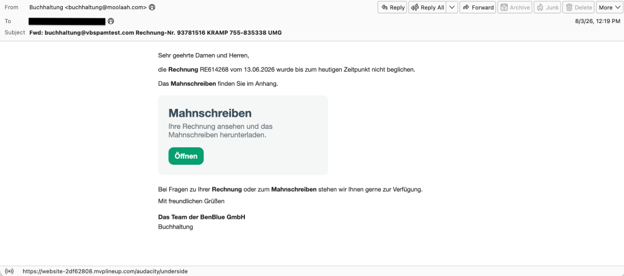 Invoice phishing sample redirecting to OpenSea.
A Romanian-language banking phishing sample observed in August 2026 impersonated BCR S.A. with a PSD2 'mandatory consent renewal' notice, warning recipients that access to web and mobile banking would be restricted unless they completed an online update by 27 August.
The message was sent from the DKIM-aligned but unrelated domain xmasbrick[.]com and contained no attachment, relying instead on a single call to action disguised as 'REÎNNOIRE CONSIMȚĂMÂNT' (consent renewal). The embedded link used IPv6-mapped URL notation, hxxp://[0000:0000:0000:0000:0000:FFFF:67C1:B3DF]/11881659, representing 103[.]193[.]179[.]223, before redirecting through web5-4s4c-online-garantibbva[.]vibtee[.]com/ro/ and eventually to Google during live verification.
The assessed threat is online-banking credential theft, with the active phishing endpoint likely cloaked, expired, or selectively serving benign content. This design made the sample harder to block because it paired convincing local regulatory language and bank branding with authenticated delivery, no executable payload, legitimate-looking footer details, and an obfuscated IP-literal URL format that can evade simplistic extraction, detonation, and reputation‑based filtering.
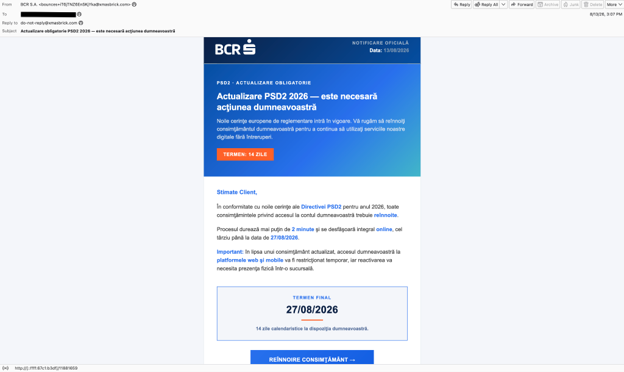 Romanian PSD2 banking phishing sample.
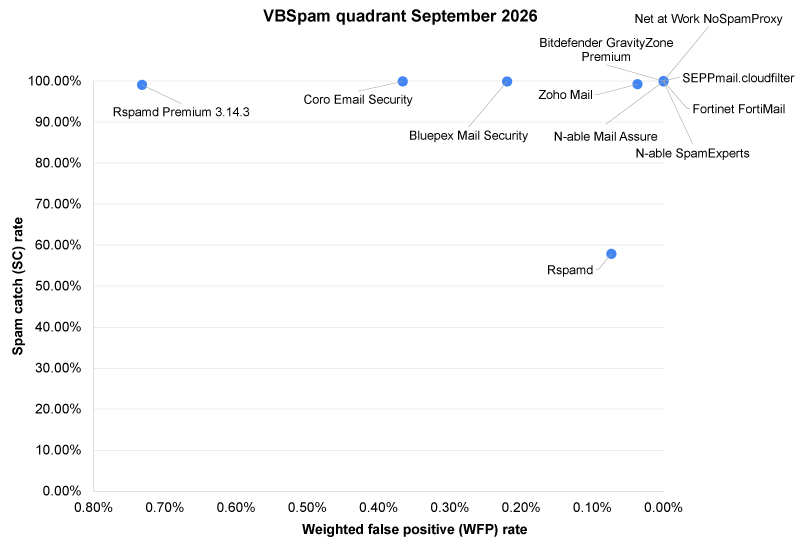
Of the participating full solutions, three achieved a VBSpam award – Bluepex Mail Security, Coro Email Security and Zoho Mail – while six others were awarded a VBSpam+ certification: Bitdefender GravityZone Premium, FortiMail, N-able Mail Assure, N-able SpamExperts, Net at Work NoSpamProxy and SEPPmail.cloudfilter.
(Note: since, for a number of products, catch rates and/or final scores were very close to, whilst remaining a fraction below, 100%, we quote all the spam-related scores with three decimal places.)
|
SC rate: 99.994%
|
 |
Bitdefender delivered an outstanding performance, combining a spam catch rate of 99.994% with no false positives and a perfect malware catch rate. Phishing detection reached 99.970%, while results across all three spam feeds were exceptionally strong. Green speed measurements throughout secure the product another VBSpam+ award.
|
SC rate: 99.887%
|
 |
Excellent detection was maintained by Bluepex, with 99.887% of spam, 99.970% of malware and 99.870% of phishing emails caught. However, false positives among legitimate mail and newsletters reduced the product's final score to 98.789, preventing it from retaining the VBSpam+ certification it achieved in the previous test. Nevertheless, consistently fast delivery and strong detection earn it a VBSpam award.
|
SC rate: 99.917%
|
|
Coro Email Security produced a strong spam catch rate of 99.917%, including a perfect result on the MXMailData feed. Malware and phishing detection were also close to 100%, while delivery speeds remained green throughout. Although a 0.37% false positive rate brought the final score down, the product still earns VBSpam certification.
|
SC rate: 99.960%
|
|
Another excellent and well-balanced performance from FortiMail saw 99.960% of spam and every malware sample blocked, without a single false positive. The product also achieved consistently strong results across the three spam feeds, with all delivery-speed measurements remaining green. A final score of 99.960 earns the product another VBSpam+ award.
|
SC rate: 99.909%
|
|
N-able Mail Assure achieved a spam catch rate of 99.909% without blocking any legitimate emails or newsletters. Malware and phishing protection remained very strong, with every message from the MXMailData feed detected, although the Abusix stream proved slightly more challenging. Fast delivery speeds throughout complete a solid VBSpam+ performance.
|
SC rate: 99.910%
|
|
Results for N-able SpamExperts closely matched those of its stablemate, with a 99.910% spam catch rate, no false positives, and a final score of 99.910. The product combined strong malware and phishing protection with perfect detection on the MXMailData feed and green delivery speeds throughout. The product comfortably earns another VBSpam+ award.
|
SC rate: 99.995%
|
|
Net at Work NoSpamProxy recorded the strongest overall result in the test, combining a final score of 99.995 with no false positives. Every malware sample was blocked, 99.990% of phishing emails were caught, and perfect detection was achieved on the MXMailData feed. Exceptional consistency and green delivery speeds throughout complete the picture for a well-deserved VBSpam+ award.
|
SC rate: 57.873%
|
Detection for Rspamd remained challenging, with only 57.873% of spam caught, although no false positives were recorded among legitimate ham emails. The product caught a little over 60% of both malware and phishing emails; the Abusix feed proved the most difficult, while MXMailData produced its strongest feed-level result. Delivery speeds were fast, but the final score of 57.507 remains well below the certification threshold.
|
SC rate: 99.069%
|
Rspamd Premium 3.14.3 showed a dramatic improvement over its performance in the previous test, raising its spam catch rate from 92.960% to 99.069% and making substantial gains in malware and phishing detection. However, a 0.75% false positive rate reduced the final score significantly. Despite much stronger detection and consistently fast delivery, the result remains short of the VBSpam certification threshold.
|
SC rate: 99.985%
|
|
Another top-tier performance from SEPPmail.cloudfilter delivered a spam catch rate of 99.985%, no false positives, and a final score of 99.985. The product blocked every malware sample, achieved perfect detection on the MXMailData feed, and recorded the highest Abusix catch rate in the test, at 99.996%. Green delivery speeds throughout help secure another VBSpam+ award.
|
SC rate: 99.230%
|
|
Zoho Mail achieved a respectable spam catch rate of 99.230% without producing any false positives among ordinary legitimate mail. Malware and phishing protection remained strong, MXMailData detection reached 99.930%, and the newsletter false positive rate improved from 3.8% to 1.9%. Although the later delivery measurements fell into the yellow bracket, the final score of 99.047 comfortably earns the product VBSpam certification.
| True negatives | False positives | FP rate | False negatives | True negatives | SC rate | Final score | VBSpam | |
| Bitdefender GravityZone Premium | 536 | 0 | 0.00% | 6.6 | 103347 | 99.994% | 99.994 |  |
| Bluepex Mail Security | 535 | 1 | 0.19% | 116.8 | 103236.8 | 99.887% | 98.789 |  |
| Coro Email Security | 534 | 2 | 0.37% | 85.6 | 103268 | 99.917% | 98.088 | |
| Fortinet FortiMail | 536 | 0 | 0.00% | 41 | 103312.6 | 99.960% | 99.960 | |
| N-able Mail Assure | 536 | 0 | 0.00% | 93.6 | 103260 | 99.909% | 99.909 | |
| N-able SpamExperts | 536 | 0 | 0.00% | 92.6 | 103261 | 99.910% | 99.910 | |
| Net at Work NoSpamProxy | 536 | 0 | 0.00% | 5.4 | 103348.2 | 99.995% | 99.995 | |
Rspamd |
536 | 0 | 0.00% | 43540.2 | 59813.4 | 57.873% | 57.507 | |
| Rspamd Premium 3.14.3 | 532 | 4 | 0.75% | 962.2 | 102391.4 | 99.069% | 95.410 | |
| SEPPmail.cloudfilter | 536 | 0 | 0.00% | 15.2 | 103338.4 | 99.985% | 99.985 | |
| Zoho Mail | 536 | 0 | 0.00% | 795.4 | 102558.2 | 99.230% | 99.047 | |
| Newsletters | Malware | Phishing | Project Honey Pot | Abusix | MXMailData | STDev† | |||||||
| False positives | FP rate | False negatives | SC rate | False negatives | SC rate | False negatives | SC rate | False negatives | SC rate | False negatives | SC rate | ||
| Bitdefender GravityZone Premium | 0 | 0.0% | 0 | 100.000% | 3 | 99.970% | 4 | 99.995% | 2.6 | 99.991% | 0 | 100.000% | 0.09 |
| Bluepex Mail Security | 1 | 1.9% | 1 | 99.970% | 15 | 99.870% | 99.4 | 99.864% | 16.4 | 99.941% | 1 | 99.960% | 0.31 |
| Coro Email Security | 0 | 0.0% | 1 | 99.970% | 10 | 99.910% | 50 | 99.931% | 35.6 | 99.871% | 0 | 100.000% | 0.43 |
| Fortinet FortiMail | 0 | 0.0% | 0 | 100.000% | 10 | 99.910% | 27 | 99.963% | 14 | 99.949% | 0 | 100.000% | 0.16 |
| N-able Mail Assure | 0 | 0.0% | 1 | 99.970% | 8 | 99.930% | 30 | 99.959% | 63.6 | 99.770% | 0 | 100.000% | 0.31 |
| N-able SpamExperts | 0 | 0.0% | 1 | 99.970% | 8 | 99.930% | 30 | 99.959% | 62.6 | 99.774% | 0 | 100.000% | 0.31 |
| Net at Work NoSpamProxy | 0 | 0.0% | 0 | 100.000% | 1 | 99.990% | 2.4 | 99.997% | 3 | 99.989% | 0 | 100.000% | 0.09 |
| Rspamd | 2 | 3.8% | 1374 | 61.440% | 4210 | 62.550% | 29983.6 | 58.896% | 12756.6 | 53.927% | 800 | 70.590% | 15.39 |
| Rspamd Premium 3.14.3 | 0 | 0.0% | 35 | 99.020% | 143 | 98.730% | 867.6 | 98.811% | 35.6 | 99.871% | 59 | 97.830% | 1.18 |
| SEPPmail.cloudfilter | 0 | 0.0% | 0 | 100.000% | 3 | 99.970% | 14.2 | 99.981% | 1 | 99.996% | 0 | 100.000% | 0.12 |
| Zoho Mail | 1 | 1.9% | 3 | 99.920% | 46 | 99.590% | 557.8 | 99.235% | 235.6 | 99.149% | 2 | 99.930% | 1.36 |
† The standard deviation of a product is calculated using the set of its hourly spam catch rates.
| Speed | ||||
| 10% | 50% | 95% | 98% | |
| Bitdefender GravityZone Premium |  |
|
|
|
| Bluepex Mail Security | |
|
|
|
| Coro Email Security | |
|
|
|
| Fortinet FortiMail | |
|
|
|
| N-able Mail Assure | |
|
|
|
| N-able SpamExperts | |
|
|
|
| Net at Work NoSpamProxy | |
|
|
|
| Rspamd | |
|
|
|
| Rspamd Premium 3.14.3 | |
|
|
|
| SEPPmail.cloudfilter | |
|
|
|
| Zoho Mail | |
 |
|
|
|
0-30 seconds | |
30 seconds to two minutes |  |
two minutes to 10 minutes |  |
more than 10 minutes |
| Products ranked by final score | |
| Net at Work NoSpamProxy | 99.995 |
| Bitdefender GravityZone Premium | 99.994 |
| SEPPmail.cloudfilter | 99.985 |
| Fortinet FortiMail | 99.960 |
| N-able SpamExperts | 99.910 |
| N-able Mail Assure | 99.909 |
| Zoho Mail | 99.047 |
| Bluepex Mail Security | 98.789 |
| Coro Email Security | 98.088 |
| Rspamd Premium 3.14.3 | 95.410 |
| Rspamd | 57.507 |
| Hosted solutions | Anti-malware | IPv6 | DKIM | SPF | DMARC | Multiple MX-records | Multiple locations |
| Bluepex Mail Security | ClamAV & Bitdefender | √ | √ | √ | √ | √ | √ |
| Coro Email Security | Coro | √ | √ | √ | √ | ||
| N-able Mail Assure | N-able Mail Assure | √ | √ | √ | √ | ||
| N-able SpamExperts | SpamExperts | √ | √ | √ | √ | ||
| Net at Work NoSpamProxy | 32Guards & NoSpamProxy | √ | √ | √ | √ | √ | |
| Rspamd Premium | ClamAV | √ | √ | √ | √ | √ | |
| SEPPmail.cloudfilter | SEPPmail, ClamAV & ESET | √ | √ | √ | √ | √ | √ |
| Zoho Mail | Zoho | √ | √ | √ | √ | √ |
| Local solutions | Anti-malware | IPv6 | DKIM | SPF | DMARC | Interface | |||
| CLI | GUI | Web GUI | API | ||||||
| Bitdefender GravityZone Premium | Bitdefender | √ | √ | √ | √ | ||||
| Fortinet FortiMail | Fortinet | √ | √ | √ | √ | √ | √ | √ | |
| Rspamd | None | √ | |||||||
The full VBSpam test methodology can be found at https://www.virusbulletin.com/testing/vbspam/vbspam-methodology/vbspam-methodology-ver30-1/.
The test ran for 16 days, from 12am on 1 August to 12am on 17 August 2026 (GMT).
The test corpus consisted of 103,969 emails. 103,380 of these were spam, 72,964 of which were provided by Project Honey Pot, 27,696 were provided by Abusix with the remaining 2,720 spam emails provided by MXMailData. There were 536 legitimate emails ('ham') and 53 newsletters, a category that includes various kinds of commercial and non-commercial opt-in mailings.
33 emails in the spam corpus were considered 'unwanted' and were included with a weight of 0.2; this explains the non-integer numbers in some of the tables.
Moreover, 3,563 emails from the spam corpus were found to contain a malicious attachment while 11,243 contained a link to a phishing or malware site; though we report separate performance metrics on these corpora, it should be noted that these emails were also counted as part of the spam corpus.
Emails were sent to the products in real time and in parallel. Though products received the email from a fixed IP address, all products had been set up to read the original sender's IP address as well as the EHLO/HELO domain sent during the SMTP transaction, either from the email headers or through an optional XCLIENT SMTP command2.
For those products running in our lab, we all ran them as virtual machines on a VMware ESXi cluster. As different products have different hardware requirements – not to mention those running on their own hardware, or those running in the cloud – there is little point comparing the memory, processing power or hardware the products were provided with; we followed the developers' requirements and note that the amount of email we receive is representative of that received by a small organization.
Although we stress that different customers have different needs and priorities, and thus different preferences when it comes to the ideal ratio of false positive to false negatives, we created a one-dimensional ‘final score’ to compare products. This is defined as the spam catch (SC) rate minus five times the weighted false positive (WFP) rate. The WFP rate is defined as the false positive rate of the ham and newsletter corpora taken together, with emails from the latter corpus having a weight of 0.2:
WFP rate = (#false positives + 0.2 * min(#newsletter false positives , 0.2 * #newsletters)) / (#ham + 0.2 * #newsletters)
while in the spam catch rate (SC), emails considered ‘unwanted’ (see above) are included with a weight of 0.2.
The final score is then defined as:
Final score = SC - (5 x WFP)
In addition, for each product, we measure how long it takes to deliver emails from the ham corpus (excluding false positives) and, after ordering these emails by this time, we colour-code the emails at the 10th, 50th, 95th and 98th percentiles:
|
(green) = up to 30 seconds |
|
(yellow) = 30 seconds to two minutes |
|
(orange) = two to ten minutes |
|
(red) = more than ten minutes |
Products earn VBSpam certification if the value of the final score is at least 98 and the ‘delivery speed colours’ at 10 and 50 per cent are green or yellow and that at 95 per cent is green, yellow or orange.
Meanwhile, products that combine a spam catch rate of 99.5% or higher with a lack of false positives, no more than 2.5% false positives among the newsletters and ‘delivery speed colours’ of green at 10 and 50 per cent and green or yellow at 95 and 98 per cent earn a VBSpam+ award.
1 For 2,749 spam samples (2.66% of the total) we were unable to find data about geographical location based on IP address.
2 http://www.postfix.org/XCLIENT_README.html.



